AI Engineering
LLM-backed features that behave: prompt architecture, structured output, retry and fallback paths, and validating what the model actually returned before it reaches a user.
Open to new projects · Remote worldwide
Building AI-powered products from idea to production.
I build AI applications, SaaS platforms, business systems and modern web applications — including the REST APIs and scalable backend architecture underneath them. I take a product from the first data model to a live deployment, and I stay accountable for how it behaves once real users arrive.
01 About
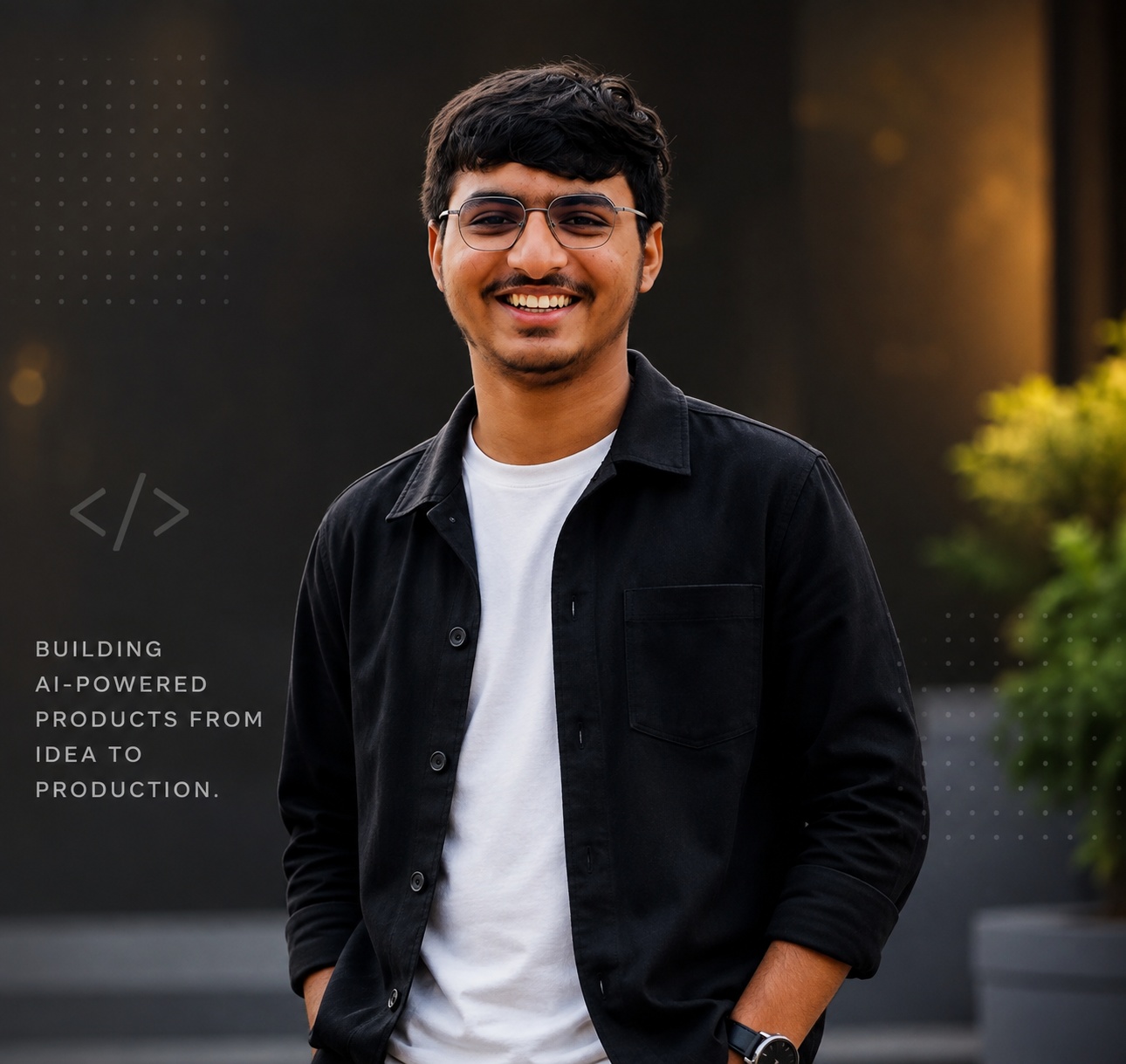
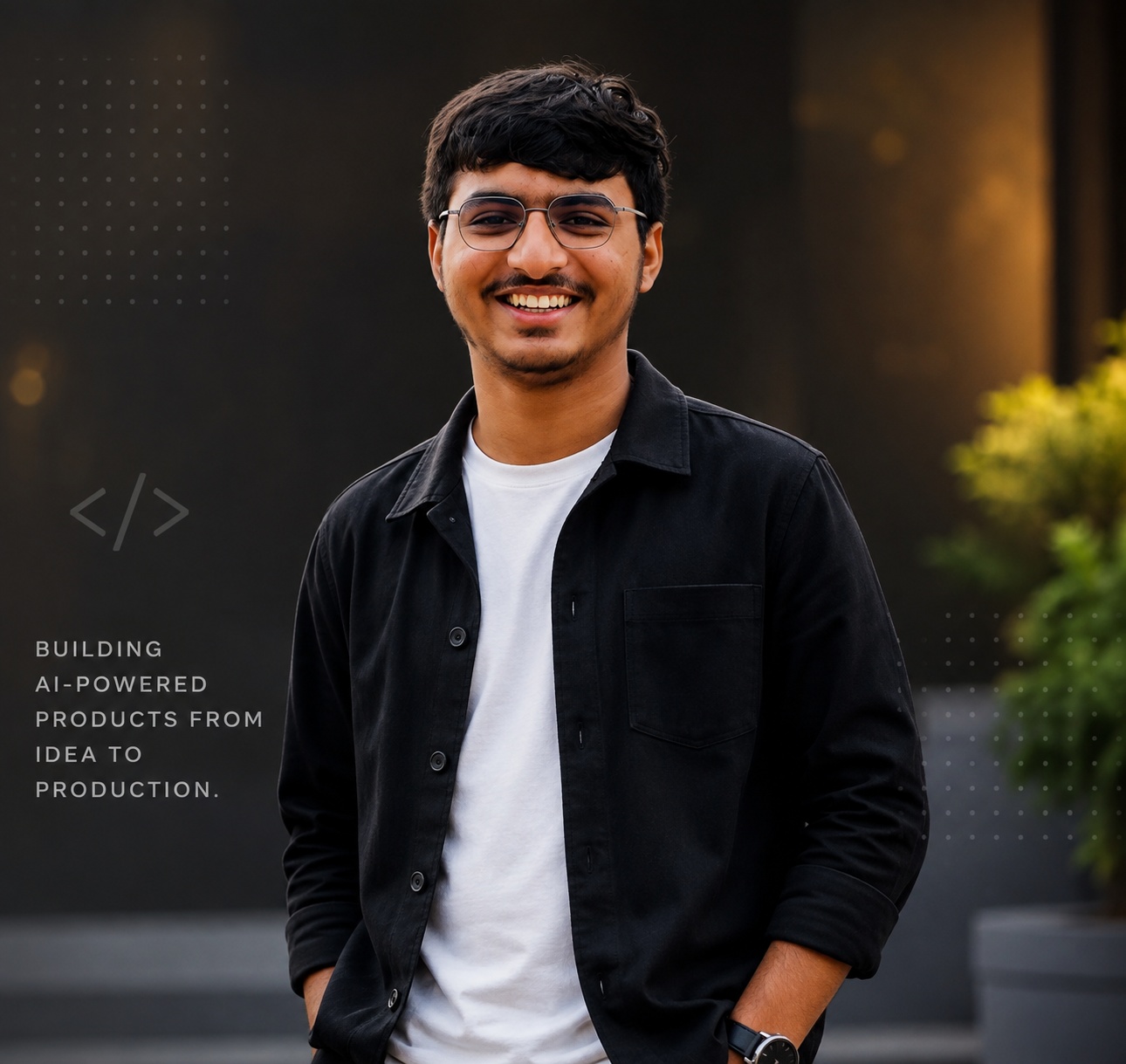
I'm Shubh Patel, a Full-Stack AI Engineer. Most of my work looks less like a website and more like a system: multi-tenant database schemas, role-based permissions, offline-capable clients, and AI pipelines that have to behave predictably even when the input is messy.
I've built and shipped two products end to end. Trendorabuy is a multi-tenant restaurant operations platform running on Laravel and AWS, with an offline-capable POS, QR table ordering and a kitchen display system. SteerHire is an AI interview platform on Next.js, Supabase and Google Gemini that reads a candidate's resume and conducts an adaptive voice interview. On both, I handled the product thinking, UI/UX, frontend, backend, database design, API layer, deployment — and everything that broke afterwards.
The parts I care most about are the ones users never see: how the data is modelled, what happens when the network drops mid-transaction, and whether a feature still holds up when a second tenant, a hundredth concurrent order or an unexpected resume format shows up.
I work directly with the people who own the product. Short feedback loops, decisions written down before code, and a codebase you can hand to another developer without an apology.
02 Core expertise
Not a list of things I've read about — these are the layers I design, write and deploy myself on real products.
LLM-backed features that behave: prompt architecture, structured output, retry and fallback paths, and validating what the model actually returned before it reaches a user.
One person across the entire request — interface, application layer, and a schema that was designed before the first controller was written.
Multi-tenant data isolation, role-based access control, tenant-scoped configuration, and the plumbing that lets one deployment serve many businesses safely.
Domain modelling, background jobs, transactional integrity, caching, and the unglamorous reliability work that keeps a product usable on a bad day.
Interfaces built for operators, not screenshots: fast, keyboard-friendly, readable under pressure, and sized for the device staff actually hold.
Relational schema design and indexing in MySQL, Postgres through Supabase, embedded SQLite for offline clients, deployed on AWS, Nginx and Vercel.
REST APIs with predictable contracts: validation at the boundary, consistent responses, authentication, and errors another developer can debug without messaging me.
Turning an unclear business requirement into a scoped, buildable system — then shipping it and iterating on what real usage exposes.
03 Selected work
Both are live. Both were designed, built, deployed and maintained by me — architecture, interface, database and infrastructure included.
Production platform · Restaurant operations
Multi-tenant restaurant operations, POS and QR ordering platform
A production business system for restaurants that replaces a stack of disconnected tools with one platform: menus, table orders, billing, kitchen coordination and staff permissions. Built as a multi-tenant SaaS so a single deployment serves many restaurants, and built offline-first because service cannot stop when the internet does.
My role
End-to-end Full-Stack Engineer — I personally handled the complete startup development: UI/UX, frontend, backend, database, APIs, authentication, architecture and deployment.
Problem
Restaurants run on thin margins and unreliable connectivity. Billing, table orders and kitchen coordination usually live in three tools that don't talk to each other, and any one of them failing stops service. Installing and maintaining a separate copy of the system per restaurant would not have scaled either.
Approach
Model a restaurant as a tenant rather than a customer record. Design the schema, permission model and configuration around tenant isolation first — then treat the POS terminal as a client that must keep working when the network doesn't, instead of a browser that assumes it will.
Solution
A single Laravel 11 deployment serving many restaurants, with role-based access control per tenant, QR-code table ordering for guests, a kitchen display system for the line, and an offline-capable POS backed by local SQLite that reconciles with the cloud MySQL database once connectivity returns.
My contribution
All of it. Product and UX decisions, Blade / CSS / JavaScript interfaces, Laravel application and domain logic, MySQL schema and indexing, REST APIs, authentication and RBAC, the offline synchronisation strategy, and the AWS + Nginx production setup with HTTPS.
Technology
Laravel 11, PHP 8.2+, Blade, MySQL, SQLite, vanilla JavaScript, REST APIs, AWS, Nginx, multi-tenancy, RBAC.
Technical outcome
Orders taken at the table, at the counter and on a guest's phone converge into one order pipeline. Billing and the kitchen display read from the same source of truth. A terminal that loses internet mid-service keeps taking orders locally and syncs afterwards, instead of stopping.
AI product · Hiring & assessment
AI interview platform with adaptive questioning and real-time voice
An AI product that runs the first round of an interview. It reads the candidate's resume, generates a role- and difficulty-specific interview, conducts it as a real-time voice conversation, probes answers that stay vague, and finishes with a structured scorecard plus written feedback for the candidate.
My role
End-to-end Full-Stack Engineer — interview flow design, resume parsing, prompt and scoring architecture, the real-time voice layer, data model, interface and deployment.
Problem
First-round screening is the most repetitive part of hiring. A fixed question list can't react to what the candidate just said, and a written test reveals very little about how someone reasons out loud or handles a follow-up.
Approach
Treat the interview as a model-driven state machine rather than a form. Parse the resume first so the conversation starts from real context, then let each answer decide what gets asked next — including a probe when an answer stays vague.
Solution
A Next.js and TypeScript application that ingests a resume PDF, builds a role- and difficulty-specific interview, runs it as a real-time voice conversation through Google Gemini, and returns a structured scorecard alongside written candidate feedback. Supabase handles authentication and persistence; the app is deployed on Vercel.
My contribution
Everything from the interview flow and resume parsing to the prompt and scoring architecture, the real-time voice interaction layer, the Supabase data model, the interface and the deployment.
Technology
TypeScript, Next.js, Tailwind CSS, Supabase, Google Gemini AI, Vercel.
Technical outcome
One configured role produces a repeatable interview that still adapts per candidate, and every session ends in structured, comparable output instead of an unstructured recording someone has to re-watch.
04 Open source
My GitHub holds additional development projects with publicly available source. Listed exactly as published — language and description straight from the repository.
05 Skills & stack
Chosen because they hold up in production, not because they trend well. Everything listed here has shipped in a real project.
Interfaces that stay fast and legible under real use.
Application logic, domain rules and the API surface.
Schema design first, queries second.
AI Agents, model-backed pipelines and computer vision systems.
Getting it live, and keeping it live.
Decisions made before the first migration runs.
06 Capabilities
These seven stages are the same on every project I take. I'm responsible for all of them — there is no point where the work gets passed to someone else.
Sit with the actual problem: who uses this daily, what breaks today, what a successful version looks like — and what is deliberately out of scope.
Data model and screens designed together. Interface decisions get much easier once the schema is honest about the domain.
Build in vertical slices so something real is usable early, and keep the codebase readable for whoever inherits it.
Wire in the third parties — AI models, storage, mail, authentication, payments — with failure paths, not just the happy path.
Exercise the flows the way staff and customers actually will: bad networks, wrong input, wrong permissions, two people at once.
Provision the server, configure Nginx and HTTPS, separate environments, handle secrets properly, and release without drama.
Watch it in production, fix what real usage exposes, and keep the product moving after launch instead of disappearing at handover.
07 Working process
Six steps, in this order. You always know which one we're in and what you'll see at the end of it.
A direct conversation about the business problem, constraints, timeline and budget. You get an honest scope back — including what I'd cut.
Schema, tenancy model, API surface and infrastructure decided and written down before any feature code exists.
Flows and layouts designed for the people using this daily: clear hierarchy, fewer clicks, nothing decorative that costs speed.
Iterative builds with working previews, so you review real software instead of reading status updates.
Functional passes across devices, permissions, edge cases and failure states before anything is called done.
Production setup, domain, HTTPS, environment configuration, handover notes and post-launch support.
08 Why work with me
No layer of account managers, no work quietly subcontracted, no gap between the person who designed the schema and the person who deploys it.
Start a conversationOne person from schema to deploy — no handoff gaps and no "that's the backend developer's problem".
Two products live in production, built end to end. Not tutorials, not clones.
The AI feature and the system it lives inside are built by the same person, so integration isn't an afterthought.
Multi-tenancy, RBAC and offline sync designed in from the start rather than retrofitted under pressure.
I build what moves the business, and I'll tell you when a requested feature isn't worth the cost.
You talk to the developer writing the code. Plain updates, honest timelines, no translation layer.
Environments, secrets handling, HTTPS, error paths and handover treated as part of the build — not extras.
Readable code and documented setup, so another developer can pick it up without a rewrite.
09 Certifications & profile
Certificates are shown here as they're issued. My professional background, achievements and verified certifications are maintained on LinkedIn.
Gujarat Technological University (GTU)
Earned top academic distinction with a 9.58 SPI, specializing in computer engineering fundamentals, computer vision, distributed systems, and modern AI development.
My verified certifications, achievements, and technical credentials are documented and maintained on my LinkedIn profile.
View verified certifications on LinkedIn10 Contact
Whether you're starting a new product, improving an existing platform, or building an AI-powered solution, let's discuss what you're trying to create.